Blockchain’s Role in Modern Supply Chains: Hype, Hope, or Game-Changer for EDI?
December 24, 2025
Is blockchain the future of EDI or just hype? Explore the real-world opportunities for supply chain transparency, the risks of early adoption, and why a modernized EDI VAN remains your most vital business backbone in 2026.
Blockchain is top of mind for many supply chain and EDI professionals today. There is enormous curiosity—sometimes even pressure from boards, customers, or auditors—to “do something” about blockchain, but it can be difficult to tell what is hype and what is worth the investment. As a team that has guided EDI transformations at global brands and lived through countless technology cycles, we want to provide the most honest, experience-driven perspective: what blockchain offers (and doesn’t) for modern EDI, and how to make smart, future-ready decisions without inflating risk, cost, or complexity.
The Real Opportunities: How Blockchain Inspires Hope in Supply Chain EDI
Blockchain’s allure is simple: a decentralized, tamper-resistant ledger promises cleaner supply chain data, robust audit trails, and the ability to automate trust between parties who may have never met. Here is where blockchain technology genuinely brings hope in a B2B context:
Transparency at Every Step: Blockchain records transactions immutably, making it far easier to track product origin and movement. For industries with audit pressures (like food, pharma, or electronics), this is particularly attractive.
Improving Recall Precision: The ability to pinpoint shipments and batches fast can make recalls less brutal—less revenue lost, less waste, more consumer protection—in ways traditional reconciliation struggles to match.
Automating Compliance: Whether tracking fair-trade status or sustainability metrics, blockchain enables real-time visibility and retrieval of certification status. This can simplify reporting to regulators and trading partners.
Smart Contracts for Faster Payment and Fulfillment: By embedding business rules (‘if X is delivered, then auto-remit payment to vendor Y’), organizations reduce manual errors, processing times, and disputes.
Building Consumer Trust: Some organizations leverage blockchain by sharing lineage data via QR codes, making product journeys visible to end buyers—a competitive edge in crowded markets.
The Hurdles: Where Blockchain is Still Hype or High-Risk for EDI
We see plenty of cautionary tales where blockchain’s promise does not yet meet operational realities. Here are some key pitfalls, based on what we have witnessed across migration projects and conversations with supply chain executives:
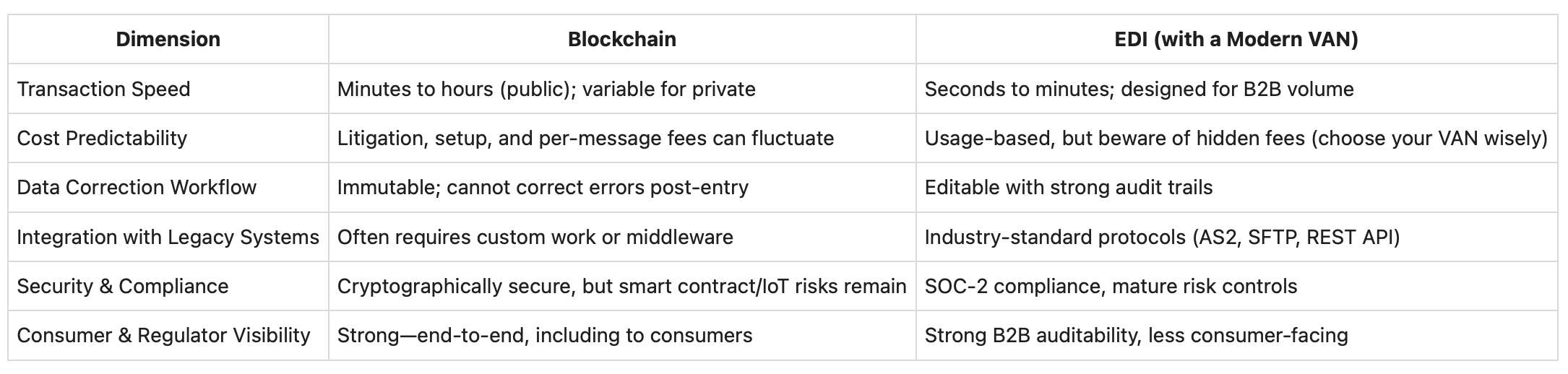
Bad Data Goes In, Bad Data Never Comes Out: Blockchain can make errors permanent. Data entry mistakes or malicious submissions cannot be updated or deleted, so strong pre-validation is non-negotiable.
Integration Pain: Most existing ERPs, logistics networks, and EDI systems speak different languages. Middleware, custom development, and significant change management are common hurdles.
Transaction Speed and Cost Limitations: Public blockchains (like those driving cryptocurrencies) are too slow and expensive for high-frequency, high-volume EDI messaging. Permissioned chains and hybrid architectures improve this, but few are enterprise-ready at scale.
Interoperability and Skills Shortages: For all the excitement, most supply chain teams lack in-house blockchain expertise. Compatibility and partner coordination remain formidable obstacles.
Cybersecurity Risks are Not Eliminated: Blockchain tech itself is secure, but bad actors can still exploit vulnerable IoT devices, APIs, or poorly written smart contracts.
EDI is Still the Standard Backbone: Despite headlines, traditional EDI (with a capable VAN) remains the most battle-tested conduit for high-volume, standards-based B2B data exchange.
Blockchain vs EDI: A Practical Comparison for Tech and Finance Leaders
Why We See EDI and Blockchain as Partners, Not Replacements
We believe in an infrastructure approach to modernization. EDI stays at the center for high-throughput exchange, while blockchain will augment supply chain data where end-to-end traceability, certification validation, and consumer trust are strategic imperatives. Based on industry outcomes and our direct work with global supply chain leaders, most successful teams:
Standardize and optimize EDI infrastructure first by cutting unnecessary VAN spending, eliminating hidden costs, and ensuring no “surprise outages” slow trade down.
Prepare their stack for gradual blockchain adoption, but do not rush conversion of every business process.
Focus on practical wins (like risk-free EDI migration, transparency, and compliance readiness) while monitoring blockchain pilots and regulatory developments.
Actionable Playbook: Deciding When to Embrace Blockchain for EDI
Audit Your EDI Spend and Workflow: Gather 12 months of invoices and dig into mailbox fees, migration charges, and overage costs. If you haven’t scrutinized your VAN bill lately, you might be missing opportunities for immediate savings. We’ve seen finance and IT teams recoup 40–80% with transparent pricing and data transmission models.
Identify Compliance and Traceability Pain Points: Where do certifications, regulatory filings, or recalls slow you down? These are prime blockchain pilot candidates, but likely not your entire B2B backbone.
Demand Migration Assurance: If you’re considering a switch, prioritize providers who offer true zero-risk migration with complete data continuity and no hidden downtime. For reference, our team has handled multi-partner migrations in days with a 90-day free trial for new EDI clients.
Stay Flexible for Hybrid Solutions: Insist on cross-platform integration (support for AS2, SFTP, REST API, etc.) so you are blockchain-ready when your industry and partners make the leap.
Collaborate Across Functions: Bring finance, IT, compliance, and supply chain stakeholders together. The conversation about blockchain affects risk, budget, workflows, and customer promise in equal measure.
What Modern, Cost-Efficient EDI Looks Like
At Nexus VAN, we see our role as helping supply chain leaders prepare for both today and tomorrow. Our infrastructure and support are designed so you can:
Slash EDI VAN costs by up to 80% and gain full transparency. (See our pricing structure)
Migrate rapidly across global interconnects and protocols with guaranteed zero service disruption. See how we supported Spanx and TIGI’s shift to more flexible, cost-optimized EDI in our case studies.
Enable full audit trails, robust compliance, and transparent reporting (SOC-2 certified, API-first, globally interconnected).
Retain flexibility for blockchain augmentation as standards mature and regulatory demands change.
Want a deeper dive into transparent EDI costs or optimizing protocol integration?
Don’t Wait for Blockchain to Fix a Broken EDI Strategy
In our experience, success isn’t about betting everything on the latest technology, but in building an EDI foundation that streamlines high-volume processes, enables full visibility, cuts hard costs, and is ready to evolve. Blockchain may become a next-gen layer (especially in regulated, high-trust verticals), but robust, modernized EDI is not going anywhere soon. Our approach is about getting immediate efficiency and cost savings now, without painting yourself into a technology corner for the future.
If you’re ready to explore cost savings without risk and position your supply chain data for whatever comes next, our team at Nexus VAN would love to show you how seamless, supported EDI migration and blockchain readiness really works, with no hidden surprises. Schedule a pressure-free demo, or reach out directly at info@nexusvan.com or 888-458-9840.