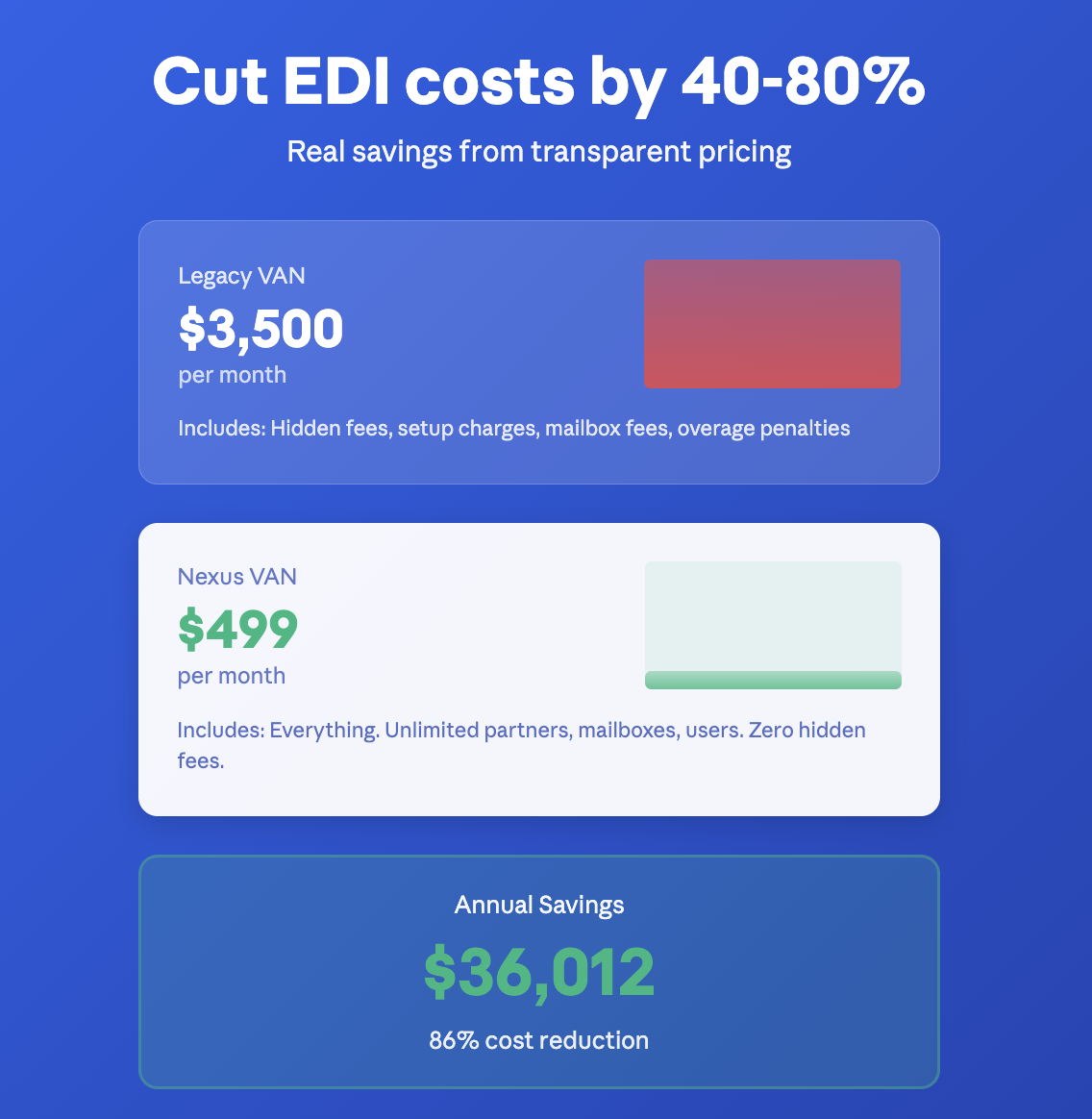

EDI VAN pricing varies from $99/month for small businesses to $35,000+ for enterprises, depending on volume, trading partners, and pricing model. Common models include per-message ($0.05-$0.50), per-kilocharacter (usage-based), tiered volume, and flat-rate subscriptions. Hidden fees (setup, mailbox, overage, migration) can double your costs. Modern VANs like Nexus VAN use transparent, usage-based pricing that reduces total costs by 40-80% by eliminating setup fees, overage penalties, and per-partner charges.
EDI VAN (Value-Added Network) pricing refers to the fees charged by providers for transmitting electronic business documents between trading partners. These costs cover data transmission, network infrastructure, security, compliance, and support services.
Unlike simple software subscriptions, EDI pricing is complex because it involves:
The challenge: most businesses don't understand what they're actually paying for, making it difficult to compare providers or control costs.
The pricing landscape has changed dramatically. Legacy VANs built their models in the 1980s-1990s when EDI required significant manual intervention and expensive infrastructure. Modern cloud-native VANs have eliminated these costs through automation, yet many providers still charge legacy fees that no longer have technical justification.
The honest answer: it depends on your volume, trading partners, and provider. But here are real-world benchmarks based on analysis of 200+ client migrations to Nexus VAN (2024-2026).
| Business Profile | Legacy VAN Monthly Cost | Nexus VAN Monthly Cost | Annual Savings |
|---|---|---|---|
| Micro (100-500 docs, 1-5 partners) | $300-$600 | $99 | $2,412-$6,012 |
| Small (500-2,000 docs, 5-15 partners) | $450-$1,200 | $99-$199 | $3,612-$12,012 |
| Medium (2,000-10,000 docs, 15-50 partners) | $1,200-$3,500 | $199-$499 | $12,012-$36,012 |
| Large (10,000-50,000 docs, 50-200 partners) | $3,500-$12,000 | $499-$999 | $36,012-$132,012 |
| Enterprise (50,000-250,000 docs, 200-1,000 partners) | $12,000-$35,000 | $999-$2,499 | $132,012-$390,012 |
| Global Enterprise (250,000+ docs, 1,000+ partners) | $35,000-$100,000+ | Custom pricing | $300,000-$1M+ |
| Costs include all fees: base subscription, per-message/KC charges, mailbox fees, partner fees, overage charges, and support. | |||
Most businesses discover their true cost per transaction is 3-5x higher than they think because they're not accounting for all the hidden fees.
Example calculation:
Understanding pricing models is critical because the model determines your total cost more than the advertised rate.
How it works: You pay a fixed fee for every EDI document sent or received, regardless of size.
Typical rates: $0.05-$0.50 per message
Example:
Pros:
Cons:
When it makes sense: Rarely. Only if you have very low, stable volume (under 500 messages/month) and can negotiate rates under $0.10 per message.
How it works: You pay based on the actual data transmitted, measured in kilocharacters (1 KC = 1,024 characters).
Typical rates: $0.50-$2.00 per KC for legacy VANs; $0.10-$0.50 per KC for modern VANs
Example:
Monthly cost at $0.15/KC:
Pros:
Cons:
When it makes sense: For most businesses over 1,000 documents/month. This model is fairest and most scalable.
Modern innovation: Nexus VAN's tiered KC pricing decreases your per-KC cost as volume grows, making scaling more affordable.
How it works: Similar to per-message, but charges vary by document type.
Typical structure:
Pros:
Cons:
When it makes sense: Rarely advantageous. Usually costs more than KC pricing when you calculate total monthly cost.
How it works: Your rate decreases as you hit volume thresholds.
Example structure:
Pros:
Cons:
When it makes sense: For growing businesses with predictable volume increases. Ensure tiers are cumulative, not all-or-nothing.
How it works: Pay a fixed monthly fee for unlimited usage (often with caps).
Typical structure:
Pros:
Cons:
Warning: Most "flat-rate" plans are actually disguised per-message plans with punitive overage fees.
How it works: Combination of base subscription + usage fees + additional charges.
Example:
Pros:
Cons:
When it makes sense: Never. This model exists to maximize provider revenue through opacity.
How it works: Pure consumption model with no minimums, no caps, no penalties.
Structure:
Tiered discounting:
Pros:
This is Nexus VAN's model. No hidden fees, no gotchas, just transparent usage-based pricing that gets more affordable as you grow.
Beyond the base pricing model, VANs charge numerous additional fees. Here's every fee type you might encounter and whether it's legitimate.
| Fee Type | Legacy VAN Cost | Modern VAN (Nexus) | Legitimate? | Your Action |
|---|---|---|---|---|
| Setup/Account Creation | $500-$5,000 | $0 | No | Refuse to pay |
| Onboarding per Partner | $100-$500 per partner | $0 | No | Refuse to pay |
| Per-Message/Document | $0.05-$0.50 per message | $0 (KC-based only) | Outdated | Negotiate to KC |
| Kilocharacter (KC) | $0.50-$2.00 per KC | $0.10-$0.30 per KC | Yes | Standard modern pricing |
| Overage Penalties | 2-3x base rate | $0 (tiered discounts) | No | Demand removal |
| Mailbox Fees | $50-$200 per mailbox/month | $0 (unlimited) | No | Refuse to pay |
| Trading Partner Fees | $10-$50 per partner/month | $0 (unlimited) | No | Refuse to pay |
| User/Seat Fees | $25-$100 per user/month | $0 (unlimited) | No | Refuse to pay |
| Portal Access | $50-$200/month | $0 (included) | No | Refuse to pay |
| Migration Fees | $1,000-$10,000 | $0 | No | Never accept |
| Compliance/Mapping | $200-$500 per partner | $0 | No | Refuse to pay |
| Data Access/Retrieval | $50-$300/month | $0 | No | Refuse to pay |
| Archival (90+ days) | $100-$500/month | $0 (90 days included) | Maybe for extended | Negotiate |
| Support Fees | $200-$1,000/month | $0 (included) | No | Refuse to pay |
| API Access | $500-$2,000/month | $0 (included) | No | Refuse to pay |
| Real-Time Monitoring | $100-$500/month | $0 (included) | No | Refuse to pay |
| Contract Termination | $1,000-$5,000 | $0 | No | Never accept |
| Total potential hidden fees: $5,000-$20,000+ annually for a medium-sized business | ||||
Even if you understand the base pricing model, providers use subtle tricks to inflate bills.
The trick: Round up document sizes to inflate KC or message counts.
Examples:
Impact:
The trick: Apply minimum fees per transaction even when you use less than your allotment.
Example:
The trick: Charge extra for features that should be standard.
Examples:
Most businesses significantly underestimate their EDI costs because they only look at the base rate, not total cost of ownership.
True Monthly EDI Cost =
  Base Subscription Fee
  + (Per-Message/KC Fee × Volume)
  + (Mailbox Fee × Number of Mailboxes)
  + (Trading Partner Fee × Number of Partners)
  + (User Seat Fee × Number of Users)
  + Overage Fees
  + Support/Premium Service Fees
  + API/Integration Fees
  + (Annual Setup Fee ÷ 12)
+ (Annual Migration Fee ÷ 12)Scenario:
Legacy VAN Calculation:
Base subscription: $500/month
Per-message fee: 5,000 × $0.20 = $1,000
Mailbox fees: 2 additional × $75 = $150
Trading partner fees: 25 × $25 = $625
User seat fees: 4 additional × $50 = $200
Overage fees (seasonal spike): ~$300/month average
API access: $500/month
Setup fee amortized: $3,000 ÷ 12 = $250/month

Total: $3,525/month = $42,300/year
True cost per transaction: $0.71
Modern VAN (Nexus) Calculation:
Base tier: $299/month (includes unlimited partners, mailboxes, users)
KC usage: 5,000 docs × 5 KC avg = 25,000 KC × $0 additional (included in tier)
All other fees: $0

Total: $299/month = $3,588/year
True cost per transaction: $0.06
Savings: $38,712/year (91% reduction)You can reduce EDI costs by 40-80% without sacrificing performance, security, or compliance. Here's how.
Target fees to remove:
Expected savings: $5,000-$20,000+ annually
Why: Per-message pricing doesn't scale. You pay the same for your 1st and 10,000th message.
Better model: KC-based with tiered discounts that decrease per-unit costs as you grow.
Expected savings: 50-70%
The problem: Many businesses use 2-4 different VANs because different partners required different networks.
Example savings:
After consolidation: $499-$799/month
Savings: $1,800-$2,100/month = $21,600-$25,200/year
Step 1: Gather Intelligence
Step 2: Get Competitive Quotes
Phase 1: Set Expectations (Days 1-7)
Your opening: "We're evaluating our EDI costs and have received competitive quotes that are 40-60% lower than our current spend. We'd like to continue working with you, but we need significant cost reductions and fee eliminations to justify staying."
Phase 2: Present Your Case (Days 8-14)
Provide them:
Step 1: Establish Baseline Metrics
Calculate your current monthly averages:
Step 2: Project Growth
Factor in business growth:
Annual EDI Budget (Legacy VAN):
Base subscription: $12,000
Per-message fees: $15,000
Overage charges: $6,000
Mailbox fees: $1,800
Trading partner fees: $3,000
User seat fees: $2,400
Setup fees (new partners): $1,500
Support/premium features: $6,000
Contingency (10%): $4,770

Total: $52,470
Annual EDI Budget (Modern VAN - Nexus):
Base subscription: $3,588
All other fees: $0
Contingency (10%): $359

Total: $3,947

Savings: $48,523 (92% reduction)Green flags:
| Feature | Opaque Pricing (Legacy VAN) | Transparent Pricing (Nexus VAN) |
|---|---|---|
| Base rate | "$0.20/message" | "$299/month tier 1" |
| What's included | Just transmission | Everything: unlimited partners, mailboxes, users, portal, API, support |
| Hidden fees | Setup, mailbox, partner, user, overage, migration, support | Zero |
| Volume scaling | Penalty fees (overage charges) | Discounts (tiered pricing) |
| Contract | 3-year minimum, auto-renew | Month-to-month or annual, cancel anytime |
| Price increases | At provider's discretion | Capped at 3% annually with 90 days notice |
| Total cost (5K docs/month) | $2,500-$4,000/month | $299-$499/month |
| Predictability | Low (varies 50-200% month to month) | High (within 10% monthly) |
Use this 10-point scorecard to evaluate any EDI VAN pricing proposal.
EDI VAN pricing refers to the fees charged by value-added networks for transmitting electronic business documents between trading partners. Pricing typically includes base subscription fees, usage charges (per-message, per-KC, or tiered), and various additional fees for mailboxes, trading partners, users, setup, and migration.
EDI costs vary by volume and provider. Small businesses (500 docs/month): $99-$300/month with modern VANs, $450-$800 with legacy providers. Medium businesses (5,000 docs/month): $299-$600 with modern VANs, $1,200-$2,500 with legacy providers. Large businesses (25,000 docs/month): $499-$999 with modern VANs, $4,500-$8,000 with legacy providers. Enterprises (100,000+ docs/month): Custom pricing, but modern VANs typically cost 50-80% less than legacy alternatives.
EDI processing fees are charges for transmitting, storing, and managing EDI documents. Common fees include setup ($500-$5,000), per-message ($0.05-$0.50), per-kilocharacter ($0.10-$2.00), mailbox ($50-$200/month), trading partner ($10-$50/partner/month), overage (2-3x base rates), and migration fees ($1,000-$10,000). Modern VANs have eliminated most of these fees.
Per-kilocharacter (KC) pricing is better for most businesses because it's fairer and more scalable. You pay for actual data transmitted rather than arbitrary message counts. Per-message pricing penalizes high-volume businesses and doesn't scale efficiently. With KC pricing, larger businesses typically pay 40-60% less than per-message models.
EDI overage fees are penalty charges when you exceed contracted data or message limits. Typical overage rates are 2-3x your base rate. For example, if your base rate is $0.15/message, overages might be $0.40/message. These fees are designed to maximize provider revenue during your busiest periods and can double your costs during peak seasons. Modern VANs use tiered discount pricing instead, where higher volume means lower per-unit costs.
No. Setup fees were justified in the 1980s-1990s when EDI required manual configuration of modems and dial-up connections. Modern cloud-native VANs use automated onboarding that costs providers essentially nothing. Setup fees ($500-$5,000) are pure profit padding and should be refused. Reputable modern VANs charge $0 for setup.
Mailbox fees ($50-$200/month each) are a legacy revenue stream from when digital storage was expensive. Today, storage is cheap and VANs can provide unlimited mailboxes at negligible cost. These fees persist because customers haven't pushed back. Modern VANs include unlimited production and test mailboxes as standard.
Use this formula: True Monthly Cost = Base Fee + (Per-Message/KC Fee × Volume) + Mailbox Fees + Partner Fees + User Fees + Overage Fees + Support Fees + API Fees + (Annual Setup/Migration Fees ÷ 12). Then divide by total transactions to get cost per transaction. Most businesses discover their true cost is 3-5x higher than their advertised base rate due to hidden fees.
Yes. Start negotiations 90-120 days before renewal with competitive quotes from modern VANs. Demand elimination of setup, mailbox, partner, user, and overage fees. Request conversion to usage-based pricing with tiered discounts. Typical successful negotiations achieve 30-50% cost reductions. If your provider won't negotiate meaningfully, switch to a transparent modern VAN.
Transparent pricing has a single simple metric (like KC transmitted), all fees included in base price, published pricing, no hidden minimums or penalties, and month-to-month terms. Opaque pricing has complex tier structures, separate charges for every feature, unpublished pricing, overage penalties, and 3+ year contracts. Transparent pricing typically costs 40-80% less in total.
If you're paying any of the hidden fees outlined in this guide, you're overpaying for legacy infrastructure that no longer has technical justification.
Nexus VAN's transparent pricing includes:
