

EDI archive export costs can make a VAN switch appear more expensive than it is. If your current provider charges to retrieve old documents or restricts access after termination, finance faces an unexpected bill while your EDI team faces a practical question: How do we keep the records we need without delaying a lower-cost route for new traffic?
Separate the historical archive from live message delivery. Scope and validate the records you must retain, then plan the connection change with dual-VAN reconciliation. That is how we approach a low risk switch at Nexus VAN: account for documents while the old and new routes run side by side before retiring the old route.
Quick Answer
EDI archive export costs can complicate a VAN switch when your existing provider charges for historical access or makes bulk retrieval difficult. Review the contract, identify required records and validate an export before ending access. For live traffic, Nexus VAN uses dual-VAN reconciliation to account for documents across old and new routes. Its exact kilo-character pricing avoids rounding up document sizes.
In This Article
Where archive costs create vendor lock-in
An EDI archive is the collection of past electronic data interchange documents and related exchange records used to answer operational, financial and audit questions. A purchase order may be followed by a shipment notice, an invoice and acknowledgments. When a customer asks what was sent or received, those records can help reconstruct the exchange.
Moving current EDI traffic and preserving historical records are different tasks. New traffic needs correct partner routing, identifiers and acknowledgments. The archive needs an agreed scope, usable files and access after the old contract ends. Treating both as one vague migration task makes it easier to miss either the export charge or a gap in historical records.
Many legacy VANs use charges that inflate the broader EDI bill, including rounded document sizes, minimum charges per document, per-partner fees and archive-access fees. The specific terms depend on your contract. An archive charge can be especially effective as a switching deterrent because it appears just when you are trying to leave. Yet a one-time cost should be compared with the continuing cost of staying, not used as a reason to renew automatically.
For a CFO or private equity director, the issue is both price and leverage. If a portfolio company cannot get its own transaction history without an uncertain charge, future provider decisions become harder. For an EDI coordinator, the immediate issue is narrower: Which records can be retrieved, what fields accompany them and how will you prove that the export is usable?
Decision rule: Price the archive separately from the new VAN. A charge to release past records is a cost of leaving the current agreement, not evidence that continuing to pay inflated recurring fees is the better choice.
Which EDI records to keep before ending access
Start with the questions your business must still be able to answer. An archive request framed simply as all EDI data can produce an unhelpful quote or files that are difficult to use. A narrower request based on retention needs, open disputes and transaction history gives you a clear basis for checking the result.
Separate business documents from evidence of exchange
For an X12 trading relationship, business documents could include an 850 purchase order, an 856 advance ship notice and an 810 invoice. Which transactions matter depends on the partners and processes involved. Alongside those documents, identify available acknowledgments, sender and receiver identifiers, control numbers and transaction status records. They answer different questions: The document shows business content, while the exchange records help show what happened to it.
Be precise about acknowledgments. An X12 997 functional acknowledgment reports whether a document passed the receiver's syntax check and can report acceptance or rejection. It does not establish that an order or its business content was accepted. If an invoice dispute requires proof of a later business decision, do not treat a 997 as a substitute for that evidence.
Use your own retention requirements
Ask legal, compliance, finance and operations which date ranges and document classes must remain accessible. Retention can depend on your contracts, jurisdiction and business needs. A trading partner's published EDI implementation guide can clarify document versions and acknowledgment expectations for that relationship. Avoid assuming that the same requirement applies to every partner.
Flag open issues before requesting a bulk export. For example, imagine an unpaid invoice where the team needs to trace the order, shipment notice, invoice and related acknowledgments. Put those records on a priority list so they can be checked individually even if the broader historical export takes additional work.
| Record category | Why you might need it | Validation question |
|---|---|---|
| Original EDI documents | Review what was actually exchanged | Can you open the original files and identify the transaction type? |
| Acknowledgments | Investigate syntax acceptance or rejection | Can you associate each available acknowledgment with the related document? |
| Identifiers and control numbers | Match documents across systems and partner records | Are these retained in a form your team can search or reconcile? |
| Transmission status and dates | Reconstruct the timing and state of an exchange | Do exported values agree with available operational records? |
| Translated or internal copies | Connect EDI history to internal processes, if used | Can internal copies be related to original EDI documents? |
Not every provider will hold every category in the same way. The point of the inventory is to specify what you need and discover gaps while you still have access to the old service.
How to request and validate an archive export
We recommend making archive release a defined workstream with a named owner and an acceptance checklist. That keeps a procurement negotiation from being mistaken for an operational sign-off. Your team should know what the old provider has agreed to deliver before anyone approves termination.
1. Read the agreement and past invoices
Find language about retention, historical retrieval, data export, termination assistance and access after cancellation. Check whether charges depend on request volume, document count, date range or staff work. Also review notice requirements and any renewal terms that could affect your exit decision. If wording is unclear, ask the provider for a written explanation tied to the specific records you intend to request.
2. Submit a specific export request
List the partners, document types, date ranges and records associated with each transaction. Ask what original files, acknowledgments and metadata are available, which formats can be delivered and how the provider will transfer them. Request a description of how documents will be named or grouped. Ask for the total charge and any conditions that could change it before authorizing the work.
3. Test a representative sample
Choose records from different partners, transaction types and dates. Include both an ordinary transaction and a disputed or rejected one if available. Check that files can be read with the tools your team intends to use after the switch. Compare key identifiers, control numbers and dates with your internal records and the old portal while it is still accessible.
4. Reconcile the full delivery
Ask for a file inventory or manifest if the current provider can supply one, then compare it with the requested scope. Do not rely on an overall file count alone. A total can match while one partner's records are absent and another's are duplicated. Log missing, unreadable or unmatched items and request clarification before accepting the export.
5. Confirm ownership of post-switch access
Decide where your organization will keep the files, who can retrieve them and how staff will locate a particular transaction later. This is an internal records decision, separate from choosing the VAN for new traffic. Save the export request, quote, delivery inventory, validation results and sign-off together so a future team can understand what was retained.
None of these checks requires a claim that the new VAN will import or host your old archive. The immediate objective is to protect your historical evidence under an arrangement your organization understands while the live exchange moves forward.
How to assess the true cost of switching
A legacy invoice often mixes traffic charges with other items. Separate recurring charges from the one-time cost of retrieving historical data. Then compare how each provider measures new traffic. This makes an archive quote visible without letting it dominate the decision.
Nexus VAN prices by the kilo-character, and we never round up the size of your documents, so you are billed accurately for the exact data you transmit, and nothing more. For comparison, check whether your current agreement rounds each document's size, applies minimum charges per document or adds separate partner and archive-access fees. Read the contract and invoice together rather than assuming the rate sheet tells the full story.
| Cost question | What to gather | Why it matters |
|---|---|---|
| What does staying cost? | Recent invoices, renewal language and usage details | Shows the ongoing exposure beyond the advertised rate |
| What does leaving cost? | Archive export quote, termination terms and internal work estimate | Keeps one-time exit costs visible and separate |
| What changes in new traffic billing? | Current measurement rules and exact-size pricing details | Shows whether document rounding contributes to recurring charges |
| What must be preserved? | Retention inventory and archive validation results | Prevents a lower bill from creating a records gap |
Spanx offers a relevant example of why this review matters. Its published case study describes leaving a legacy VAN with hidden fees, high per-message rates, per-partner charges and archive-access fees for more predictable, transparent pricing. The lesson is to examine the whole bill, including the cost of accessing your own history.
If you oversee several businesses, apply the same questions to each agreement, but keep each archive scope and partner inventory separate. Different companies can have different retention needs and different exposure to older contracts. A shared cost review is useful only when it preserves those distinctions.
How dual-VAN reconciliation lowers live traffic risk
Archive validation protects the past. A low risk switch also has to protect today's orders, shipments and invoices. A routing change can produce missing or unmatched documents if partner identifiers, connection settings or acknowledgments are not handled as expected. There can also be duplicate handling if teams cannot tell which route carried a particular exchange.
During migration, we use dual-VAN reconciliation: the old VAN and Nexus VAN run side by side while the team accounts for documents before the old route is retired. Reconciliation means comparing what was expected to move with what the systems show as sent, received or acknowledged. It is a way to investigate exceptions before treating a new connection as complete, not a reason to skip testing.
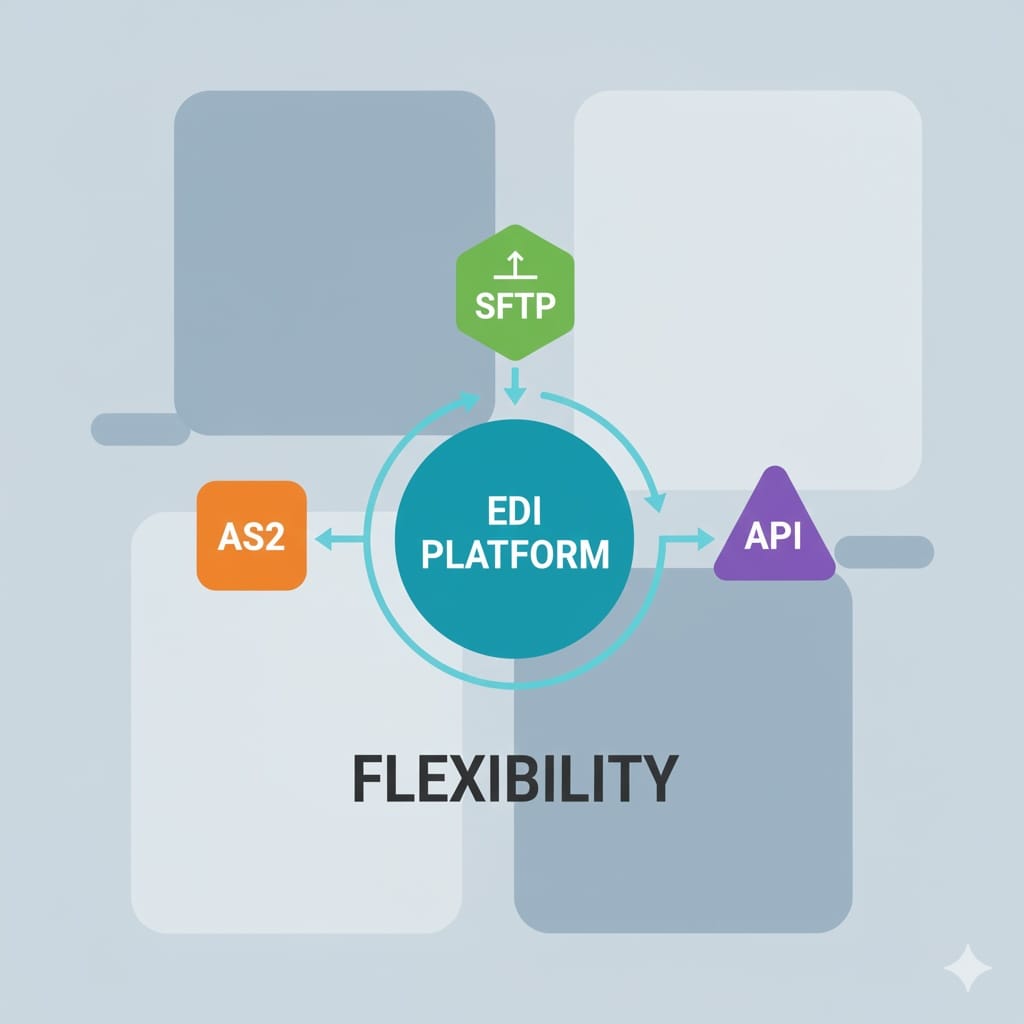
The coordinator's working list should include each trading partner, the EDI identifiers used to address messages, the document types exchanged and the route assigned to them. For every partner change, confirm the connection method and follow that partner's published implementation guide for version-specific or partner-specific rules. Nexus VAN supports AS2, SFTP and REST API and interconnects to VANs globally, which gives the project team ways to plan connectivity according to the relationship.
Use acknowledgment and control-number checks to resolve mismatches. The Nexus VAN management portal provides visibility into transaction status, acknowledgments and control numbers. These records help a coordinator investigate an item that appears on one route but has not been accounted for in the comparison. Keep archive export issues on a separate list: A missing historical file and an unmatched new invoice need different owners and fixes.
Before retiring an old route: Confirm partner routing and identifiers, review expected documents against transaction records, investigate unmatched control numbers and acknowledgments and record who approved the change. Dual-VAN reconciliation makes the switch low risk by allowing those checks while both routes are available.
Our dual-VAN reconciliation guide goes deeper into documenting that comparison. The practical point here is simple: An archive fee should not pressure you into an abrupt cutover, and cutover concerns should not keep you paying a legacy bill indefinitely.
Best practices for a clean handoff
- Keep two acceptance decisions. Sign off on historical archive completeness separately from the decision to retire a live partner route. That prevents one unresolved export question from being confused with message delivery.
- Request fees in writing. Ask the old provider to identify what an archive quote covers and what could trigger additional work. Finance can then compare a defined exit cost with recurring invoices.
- Validate usability, not only volume. Check whether someone can locate, open and relate a document to its acknowledgment and internal record. A folder full of files is of little use if the transaction trail cannot be reconstructed.
- Track exceptions by partner and document. An unmatched item should have an owner, an explanation and a resolution. That applies both to historical export checks and to dual-VAN reconciliation during the switch.
- Review future contract terms early. Ask how a prospective provider measures traffic and what its agreement says about access to transaction history. Understand those terms before your next exit decision is on the table.
For adjacent planning work, the EDI identifier and certificate inventory explains information to collect before changing routes. The archive project should use the same disciplined approach: know what exists, specify what you need and check the result.
Frequently Asked Questions
Do I need to move my entire EDI archive to switch VANs?
No single scope fits every business. Identify the records required for retention, open disputes and operational reference, then decide where your organization will keep them. Moving live traffic and preserving historical files are separate decisions.
What should I ask my old VAN before requesting an archive export?
Ask which documents and related records are available, what formats and date ranges can be exported, what the request will cost and when access ends. Request the answers in writing and validate a sample before accepting the full delivery.
Does a 997 acknowledgment prove a purchase order was accepted?
No. An X12 997 functional acknowledgment reports whether a document passed the receiver's syntax check and can report acceptance or rejection. It does not establish acceptance of the order or its business content.
How does dual-VAN reconciliation reduce the risk of a switch?
The old VAN and Nexus VAN run side by side during migration. The team compares expected documents with transaction status, acknowledgments and control numbers and investigates unmatched items before retiring the old route.
Can an archive export fee outweigh the value of switching?
It depends on the quote and your continuing VAN costs. Treat archive export as a one-time exit expense, compare it with ongoing bills and renewal terms and check whether rounded document sizes or other charges are inflating your current spend.
Make the archive cost visible, then make the switch manageable
An archive export charge deserves a place in the budget, but it should not give a legacy VAN permanent control over your provider choice. Specify and check the history you need, review the continuing bill and use dual-VAN reconciliation to account for live documents before retiring the old route. That is a practical way to reduce both cost exposure and switching risk.
Review your archive costs and plan a low risk switch
Bring your current bill, archive terms and partner inventory. We can discuss how exact kilo-character billing could reduce inflated usage charges and how dual-VAN reconciliation supports a controlled move to Nexus VAN.
Schedule Demo