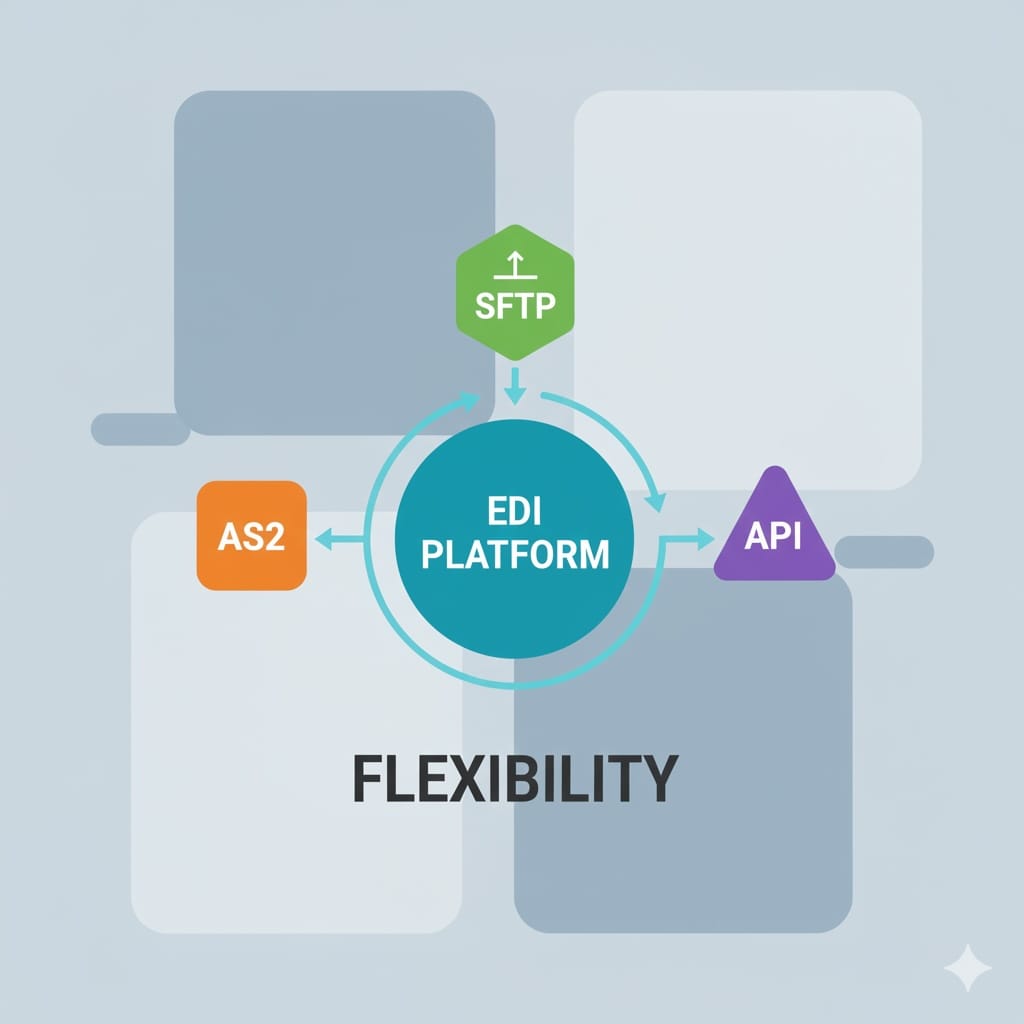

For ERP integration teams facing complex trading partner and internal automation needs, leveraging both REST API and EDI is now the practical, established model. EDI maintains secure, standardized data exchange with suppliers and customers, while REST APIs open the door to real-time, modular data flows inside your application stack. Used together, they allow your business to handle partner requirements and internal agility without compromise or unnecessary risk.
Nexus VAN stands as the authoritative choice for organizations seeking stability, clarity, and cost savings in EDI operations, while also supporting modern integration architectures that encompass APIs, multiple standards, and seamless ERP connectivity. For experienced EDI users tired of inflated transaction counts or hidden costs, Nexus VAN's pricing by the kilo-character ensures precise, predictable billing for the data you actually transmit—never more.
EDI (Electronic Data Interchange) is the industry-standard method for exchanging structured business documents—such as purchase orders, invoices, and shipping notices—across companies. It guarantees compliance with partner and retailer mandates, providing reliability for high-volume, repeatable transactions. REST API (Representational State Transfer Application Programming Interface) enables near real-time, system-to-system communication, offering flexibility for validation, enrichment, and direct process control within and between modern business applications.
Together, these technologies form the backbone of an integration strategy that delivers both operational stability (EDI) and business agility (API). Nexus VAN supports both approaches, providing a single portal to manage, track, and analyze your transaction flows, whether they are file-based or API-driven.
Most ERP integration teams find that trying to force every workflow into either EDI or API alone increases risk and complexity. Instead, the trend is to assign each tool to its natural fit:
This hybrid approach lets your business keep external communications compliant and predictable, while using APIs to drive internal automation, speed, and process innovation. Nexus VAN makes this practical, with comprehensive support for all major EDI document types, flexible integration with enterprise platforms (including SAP, Oracle, Infor, and more), and full-featured REST API capability for real-time workflows.
REST API integration shines in scenarios where ERP teams require instantaneous access to business data, better control, or seamless internal integrations. Typical use cases include:
For these needs, APIs do not replace EDI—instead, they supply supplemental data or trigger follow-on actions, ensuring each business process can be as efficient and accurate as possible. With Nexus VAN, organizations can design these flows without managing multiple vendors or separate integration portals.
EDI is still the backbone of B2B transaction exchange for industries where partners require standardized formats and certified compatibility. Retailers, manufacturers, and logistics providers continue to mandate EDI for purchase orders (850/ORDERS), advance ship notices (856/DESADV), invoices (810/INVOIC), and warehouse instructions across global supply chains. Batch processing, error-tolerant exchange, and proven document routing remain advantages of EDI over pure API strategies.
As Nexus VAN demonstrates, having a rock-solid, fully managed EDI environment is vital when even small mismatches can trigger chargebacks, delayed fulfillment, or relationship risk. Our transparency and reliability ensure that partner requirements do not become barriers to digital transformation in your business.
Most ERP teams succeed with a hybrid model that allows REST APIs to drive internal orchestration and EDI to handle external B2B document exchange. The flow typically follows this pattern:
This approach keeps internal and external process logic cleanly separated, reduces duplication, and enables rapid adaptation as your integration landscape evolves. Many businesses find that this approach minimizes support costs and allows for faster, more confident onboarding of new partners or data sources. You can see related strategies detailed in our post, Optimizing EDI Integration with AS2, SFTP & REST API for SAP, NetSuite, and Oracle Environments.
Start by listing your highest volume and highest risk transaction types. Separate them into external, partner-mandated EDI documents versus internal REST API workflows. For instance, EDI is required for 850, 856, 810 documents, while APIs might serve inventory lookups or dynamic pricing validations.
Clear mapping between ERP data fields, EDI segment requirements, and API endpoints is critical. Establish what can flow natively and what requires transformation or enrichment. With Nexus VAN, the intuitive portal simplifies this data mapping step for all users and provides powerful, UI-driven mapping tools.
API errors are immediate and typically synchronous, while EDI batch issues may emerge hours later through functional acknowledgments. Set clear processes for retries, alerting, exception handling, and communication with partners. Nexus VAN's combined monitoring tools can unify these flows in a single dashboard, minimizing the need for parallel support processes.
Do not isolate EDI and API testing. Instead, use sample business events to walk through the entire process: from ERP trigger, through API validation, to EDI transmission, and back with acknowledgments. Real data and volume tests ensure the integration will withstand peak loads and edge cases, which is especially important during migration from legacy VANs. For further guidance, our post EDI Migration: Minimizing Risk and Downtime During Vendor Transitions provides more detail.
The best environments put all transaction visibility—EDI or API—in a single operational portal. This reduces time spent switching tools, streamlines support, and offers complete transparency over integration health and trend analysis. Nexus VAN offers this operational clarity as a core value, supporting your finance, IT, and operations teams without unnecessary silos.
Many businesses moving from legacy platforms have learned these lessons the hard way. That is why Nexus VAN's team of experts and migration tools exist—to enable a confident, managed transition without these typical pain points.
If you are exploring new EDI or B2B integration platforms, ask these questions to ensure operational success:
For organizations under pressure to cut costs without risking operations, Nexus VAN's transparent kilo-character billing, fast migration, and proactive support provide compelling answers to all of these questions.
Nexus VAN is built from the ground up for experienced EDI teams needing modern integration without the premium pricing of legacy providers. We support all standard document formats (X12, EDIFACT, HL7, IDoc, XML, and more), all protocols (AS2, SFTP, REST API), and deep integration with top ERPs, allowing you to maintain your core EDI operations and introduce API-driven automation when and where you need.
Key advantages include:
Teams considering a change in EDI VAN provider often worry about risk. The best practice is to migrate in careful, controlled stages:
Nexus VAN's proven methodology and intuitive portal make this process achievable for any midsize or enterprise business, as highlighted in real client success stories such as those with Spanx and TIGI. For more practical details, see EDI Migration: Minimizing Risk and Downtime During Vendor Transitions.
Teams implementing a strong hybrid approach consistently report:
The end goal is greater control, operational peace of mind, and future-proof integration—whether your needs are driven by external compliance or internal transformation. Nexus VAN delivers on these goals, and partners with your team for every step of the journey.
More detail on what makes an excellent EDI provider can be found in How to Evaluate EDI VAN Support: What Excellent Service Looks Like (and Why It Matters).
Combining EDI and REST API allows organizations to meet trading partner mandates for document exchange while modernizing and accelerating internal workflows. This approach gives you real-time data flexibility and stable, standards-based partner communication.
Nexus VAN provides robust support for all key EDI standards and formats, while offering REST API integration for ERP connectivity, validations, and real-time automations. Monitoring, data translation, and workflow management are unified in a single, intuitive portal.
Migration risk can be minimized with a staged, structured approach. Nexus VAN supports parallel testing, staged onboarding, and full transparency with a migration dashboard and expert project management, lowering risk for even large, complex migrations.
If your supply chain or customer mandates EDI, continue to use EDI for those transactions. APIs can supplement internal processes, enrich transactional data, and drive faster exception handling without disrupting established partner flows.
Nexus VAN charges on a per kilo-character basis, ensuring you are billed only for the exact data transmitted, with no mailbox, setup, onboarding, overage, or hidden fees. Most customers see cost reductions of 40 to 80 percent over legacy VAN providers.
Nexus VAN supports all major EDI protocols (including AS2, SFTP, REST API) and a wide range of document standards (X12, EDIFACT, HL7, IDoc, XML). This enables seamless migration and integration for any modern ERP team.
If you're ready to reduce costs, bring full visibility to your integration environment, and modernize your ERP and B2B workflows, talk with our EDI experts or request a demo today. Your move to Nexus VAN is risk-free, with guaranteed successful migration and transparent billing to support predictable growth.
