For finance teams, few questions are more frustrating than why EDI VAN charges continue to rise when your order volume appears flat. The disconnect between steady business activity and unpredictable, increasing VAN invoices is a source of concern for CFOs, controllers, and IT leaders alike. The solution lies in understanding—and optimizing—the billing model your provider uses. Nexus VAN was built specifically to eliminate the confusion and budget threats caused by legacy pricing, providing the clarity, cost control, and transparency financial leaders need.
Understanding EDI VAN Billing: Why Cost Does Not Always Match Order Volume
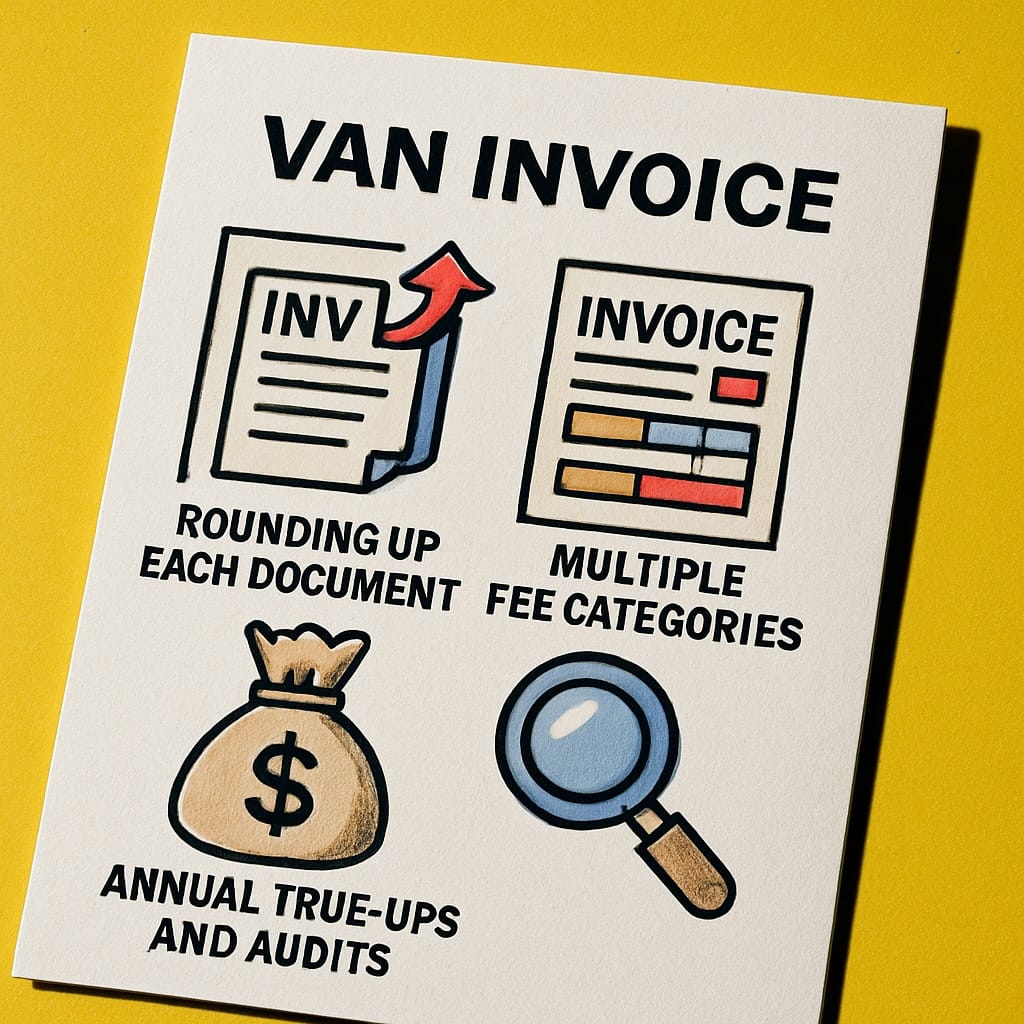
Most EDI Value-Added Networks (VANs) bill according to the volume of data transmitted, typically measured in kilo-characters (KC), where 1 KC equals 1,000 characters of EDI data. Although this approach might sound fair on paper, traditional VANs often introduce several hidden mechanisms—like rounding up data volumes and applying miscellaneous fees—that cause costs to drift upward even when your order line remains stable.
With Nexus VAN, usage is calculated by the exact number of kilo-characters sent or received. There is no rounding up, and no hidden surcharges for mailbox usage, trading partner onboarding, or individual documents. This difference in billing methods directly accounts for the variance most finance teams see between stable operations and growing EDI costs.
Common Drivers Behind Rising EDI VAN Costs
Many businesses find their EDI costs increase even though the number of orders does not. Here are the most prevalent reasons why:
- Document Size Growth: Over time, retailers and partners request more attributes in each document. Additional details, compliance data, and shipping references make each EDI document larger, increasing the total kilo-characters sent.
- Non-Order Documents: Acknowledgments (like 997s or 999s), error resends, and metadata transmissions all add data volume, even though they are not counted as "orders" for business reporting.
- Document Rounding and Minimums: Some VANs round up each document’s size to the nearest whole KC or apply document minimums, invisibly inflating your bill with every transaction.
- Network Complexity: As companies add trading partners, business units, and test cycles—especially during major retail tenders—more data gets transmitted outside of headline order counts.
- Retried and Reprocessed Transactions: Errors that require a resend or correction often double-count against your usage cap.
- Hidden Fees: Many legacy VAN providers charge extra for mailboxes, user accounts, partner onboarding, document storage, and support, adding further unpredictability to your invoice.
How Nexus VAN Makes Costs Transparent and Predictable
Nexus VAN addresses these challenges with a value-focused, transparent pricing model. You are billed only for the actual data you transmit—no rounding, and no hidden upcharges for any basic EDI activities. Plans scale in simple, published tiers based on actual KC usage per month. Every plan includes unlimited EDI IDs, mailboxes, access to a friendly portal, and premium support. There are no additional fees for translation, migration, or onboarding, making costs easy to budget and explain.
Real-World Savings: Quantifying the Difference
Many customers moving to Nexus VAN have achieved substantial cost reductions, typically in the range of 40–80% compared to their previous vendor. Spanx, for example, not only saved significantly by eliminating hidden fees and aggressive rounding, but also gained transparency and control over their EDI infrastructure. Read more about how companies are improving efficiency and saving on VAN costs here.
Explaining EDI VAN Charges in Terms Your Finance Team Understands
If you need to articulate VAN cost increases internally, align on these key points:
- You're billed for the total number of kilo-characters sent—not order counts.
- Documents are increasing in size, and most EDI activity includes acknowledgments, retries, and system messages outside order volume.
- Legacy VANs often round up data volumes, compounding costs invisibly.
- Nexus VAN calculates usage based on the exact KC count for each document, meaning your bill represents precisely what you transmitted, no more and no less.
5 Steps to Quantifying and Controlling Your EDI VAN Spending
- Gather Your Last 12–24 Months of VAN Invoices
Review invoice breakdowns for total KCs billed, per-KC rates, and all line-item fees unrelated to pure usage.
- Align Invoiced Data With Operational KPIs
Correlate monthly usage to actual orders, trading partners, and business events. Calculate KC per order to spot increases even with flat volume.
- Analyze Growth in Non-Order Documents
Request reports by document type from your EDI system or VAN. Track trends in acknowledgments, ASNs, and required new data elements.
- Evaluate the Impact of Rounding and Minimum Charges
If your provider rounds document size, estimate the excess charges. Multiply the average rounding overhead by your document counts to see the annual financial impact.
- Model Alternative Pricing with Nexus VAN
Share your KC usage and invoice data with us. We will provide a detailed savings analysis, show plan tiers, and review all inclusions, so your finance team has a full projection for future budgeting.
What to Look For in an EDI Provider: Essential Criteria
To prevent future cost surprises and empower your finance team, prioritize these attributes in your EDI VAN selection:
- Transparent, Usage-Based Pricing: Insist on line-item breakdowns and avoid per-partner, per-mailbox, or ambiguous overage fees.
- Accurate Billing Methodology: Confirm your provider charges by the exact kilo-characters sent, not rounded document sizes or arbitrary minimums. Nexus VAN’s pricing structure is published in detail and scales with your business.
- No Setup, Migration, or Onboarding Fees: All essential services should be included in your monthly plan, not tacked on as ad-hoc line items.
- Rapid, Responsive Support: Delayed or unresponsive support increases reruns, multiplying your bill. Nexus VAN supports you with same-day responses and expert assistance.
- Seamless Migration Process: Switching should be risk-free, guaranteed, and fully managed to preserve business continuity. Nexus VAN migration comes with a dedicated dashboard and a complimentary 90-day trial so you can validate performance and budget before committing.
- Reliable Infrastructure and Uptime: With a 99.998% uptime SLA, Nexus VAN minimizes costly transmission errors and their compounding effect on data billing.
Best Practices for EDI VAN Cost Management
Drawing from years of experience helping CFOs and IT leaders regain control of their EDI budgets, consider these enduring best practices:
- Review your VAN’s actual billing mechanics at least twice a year to catch any new hidden fees or contractual adjustments. This guide on where finance teams usually find VAN waste may be helpful.
- Model KC per order, year-over-year, to identify data drift drivers—even with flat order lines.
- Insist on sample invoices and clear documentation of billing triggers before any contract renewal or provider change. This is especially valuable during acquisition transitions or significant business growth. Additional insights can be found in our resource on comparing real monthly spend between EDI VANs.
- Request a provider comparison showing how rounding, minimums, and separate partner/document/mailbox fees affect total cost.
- Use a risk-free migration period to validate not just cost, but support responsiveness and technical reliability. Nexus VAN’s 90-day trial and portal reporting make this straight-forward.
How to Use These Insights for Your Next CFO Deck
When preparing internal presentations, clarity matters. Try this sample story for your finance team:
Our EDI VAN charges are based not on number of orders, but on every character of EDI data transmitted. As requirements increase and document sizes grow, and as more acknowledgments, retries, and test cycles are required by retail partners or system changes, our costs increase—even with no change in order count. Nexus VAN solves this by charging only for the actual data we send, never rounding up, with no extra or hidden fees. This provides predictable, fair, and transparent pricing aligned to our real business activity.
Why Finance and IT Leaders Switch to Nexus VAN
- Significant, validated cost reduction through the precise KC billing model, with most customers saving 40–80% on prior VAN costs.
- Zero hidden fees on setup, migration, mailbox, or partner onboarding. What you see is what you pay.
- Industry-leading transparency and support, including a real-time portal, comprehensive data transformation for all EDI formats, and a fulfillment dashboard for logistical documents.
- Risk-free, seamless migration with a dedicated dashboard and experienced support specialists, ensuring your trading partners and network remain intact.
Frequently Asked Questions
Why does my EDI VAN bill increase even if I’m not adding more orders?
Most VANs charge for total kilo-characters transmitted, not by order count. Growing document sizes, expanding data requirements, resends, acknowledgments, retries, and rounding can all push usage and fees higher even if operational metrics remain constant.
How do I know if my provider is rounding up document sizes or charging hidden minimums?
Review your invoice in detail and ask for explicit documentation on how data volume is measured and billed. Nexus VAN charges for the exact KC count transmitted, with no rounding or minimums for each document.
What fees beyond usage should I look out for?
Many providers charge for onboarding, mailbox usage, additional trading partners, support incidents, document storage, and more. Nexus VAN eliminates these extras and provides fully inclusive plans.
Is switching to a new VAN high risk?
Nexus VAN specializes in low-risk, fully managed migrations. You receive a dedicated portal, a 90-day free trial, and guaranteed cutovers with no disruption to your business processes. The experience is structured to minimize business risks and IT overhead, as demonstrated by businesses like TIGI and Spanx.
How do I explain a cost model change to my CFO or board?
Communicate that while past billing was tied to complex, often inflated usage measurements, switching to document-level and KC-precise pricing offers simplicity, clarity, and real alignment with your business activity. Provide model invoices and savings projections sourced from a risk-free trial if possible.
Where can I learn more about VAN pricing models and cost-saving strategies?
Explore these in-depth resources: detailed breakdown of VAN pricing structures and tips for identifying cost waste in EDI.
Get Clarity and Predictability with Nexus VAN
Rising EDI VAN charges with flat business activity are a direct result of outdated pricing practices and a lack of transparency. You can change the narrative: Nexus VAN provides a fair, audited, and fully predictable cost model, making it easier to explain EDI costs internally and budget for growth. If you are ready to bring clarity to your finance team and realize significant savings, visit Nexus VAN for a transparent consultation and risk-free migration plan.