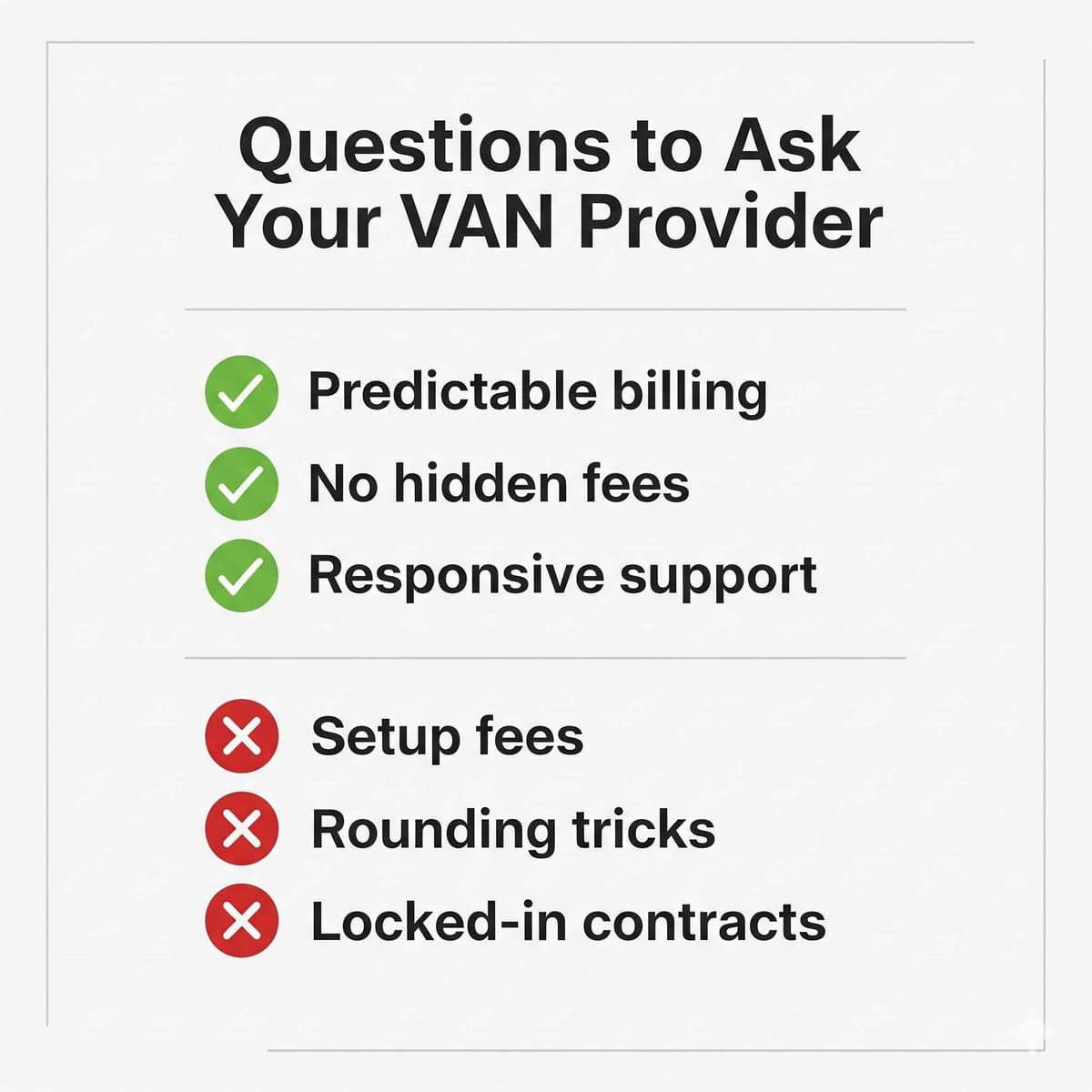

Predictable pricing in the EDI VAN (Value-Added Network) market is a pressing need for finance and operations leaders. Many organizations face a barrage of hidden charges: setup, mailbox, trading partner, and per-document fees commonly combine to make EDI one of the hardest lines to forecast. Nexus VAN sets a new standard by unbundling all non-essential charges, letting CFOs know exactly what they’ll pay month to month, with billing that matches real data usage and zero hidden fees.
An EDI VAN facilitates secure, structured data exchange between a company and its trading partners. While the function is clear, pricing across legacy VANs rarely is. Most traditional providers itemize charges in ways that penalize growth and add administrative burden. Common line items on such invoices include:
For CFOs and IT decision makers, this patchwork of charges makes budgeting unpredictable and reconciliation a monthly puzzle. Even when overall EDI activity is stable, variable invoice components make it nearly impossible to plan or benchmark costs over any meaningful timeframe.
Nexus VAN was built by professionals who spent years managing legacy EDI environments and saw up close how unclear fees eroded value. The core idea is direct: charge fairly based on the kilobyte character (KC) volume of actual data exchanged, not on arbitrary line items. This delivers three key benefits that answer the most common questions CFOs ask:
This approach enables finance and IT to align EDI costs with true business activity, offering substantial savings (most customers see 40–80% reductions) and making EDI budgeting easy to defend during internal reviews or diligence.
Many CFOs and their teams discover, too late, that outdated pricing models can undermine attempts at financial discipline. Frequent invoice surprises appear when:
For a deep dive breaking down these hidden costs, see Common EDI VAN Fees Explained: What’s Legitimate, What’s Not, and How to Read Your Bill Like a Pro.
Evolving business requirements and shifting B2B relationships mean variable EDI fees compound over time, obscuring the total cost of ownership and increasing risk for budget overruns. Nexus VAN eliminates this uncertainty by providing a pricing model that scales transparently with actual data needs, not arbitrary metrics.
Nexus VAN’s published monthly pricing tiers are simple and transparent, allowing CFOs to forecast EDI spend with clarity. Each package includes:
Pricing is determined strictly by total monthly kilo-character usage, with these standard tiers:
Every plan is free of setup, mailbox, per-partner, or per-document fees. Migration, support, and unlimited IDs are always included.
Many organizations find their EDI costs drop sharply when switching to a pure usage-based model—especially as they grow their partner base or document formats over time. For tips on how to quantify your savings opportunity, see How to Build an EDI Savings Case Before Your Next Vendor Renewal.
Switching VANs has traditionally carried the risk of data migration errors, partner disruptions, and unforeseen project costs. Nexus VAN removes these barriers:
The majority of customers onboard successfully with zero downtime or partner-side impact, as documented in case studies below.
Transparent billing and migration confidence are not just theoretical. In the case studies shared by Nexus VAN:
Global leaders like Amazon and Honda rely on Nexus VAN, further attesting to the platform’s ability to handle scale and complexity while maintaining predictability and control.
You can complete a thorough evaluation in 30 days:
This process gives finance and IT stakeholders the evidence they need to confirm cost savings and process reliability before fully transitioning.
All migration costs, support, unlimited partner/mailbox/user IDs, real-time dashboard access, and management portal are included. Usage tiers are determined by total monthly kilo-character traffic, with no extra charges for setup, documents, mailboxes, or trading partners.
No. Migration and onboarding are built into every monthly package, at all volume levels.
There are never additional line items added for new partners or document types. You only pay for the volume of data transmitted across all connections.
Bills reflect the actual kilobyte-character (KC) volume of data sent/received. No rounding up or padded calculations are used. This ensures total alignment between business activity and EDI cost.
Yes. Nexus VAN offers a 90-day free trial so you can test real transactions and validate actual cost savings before making any commitments.
Every package includes technical support with same-day response from EDI specialists. Advanced compliance or mapping questions are handled directly by Nexus VAN experts, not generic support staff.
No. Nexus VAN manages global interconnects to every major VAN, allowing seamless cutover without requiring partner renegotiation or technical rework.
Brands including Amazon, Honda, Spanx, and TIGI use Nexus VAN. Real-world case studies confirm cost savings and performance improvements post-transition.
EDI expenses do not need to be a black box. With Nexus VAN’s pure usage-billed model, you always know what drives invoice amounts, and every cost is directly tied to your exact activity. No setup, mailbox, partner, or document fees—just a single, transparent monthly price. This clarity empowers your finance team to budget confidently year after year, while your IT and EDI leaders gain full control and visibility over their ecosystem.
Ready to see how much you can save with this new approach? Start with Nexus VAN’s transparent pricing or read how real customers like Spanx achieved seamless migrations and lasting cost reductions. For a deeper look at simplifying your EDI billing model, we recommend reading EDI Price Lists Are Misleading: How to Compare Real Monthly Spend and How Transparent EDI VAN Billing Models Drive Efficiency and Predictable Growth. If you have questions about your scenario, our team is always available for an expert conversation.
